How Dropshippers Use Virtual Cards to Manage Multiple Ad Accounts and Avoid Bans
If you have run paid traffic for a dropshipping store, you already know the feeling. You wake up, check your phone, and there it is: account disabled. No warning, no clear reason, just a banner explaining your business is no longer welcome on the platform. Your morning is now about appeals and replacement accounts.
Most dropshippers blame creatives, copy, or the product. Sometimes that is the issue. Often, though, the real culprit sits one step earlier in the funnel: the payment method.
The Account Ban Problem Nobody Warned You About
Meta and Google have spent the last few years aggressively cracking down on what they call “suspicious billing patterns.” That phrase covers a lot of ground. Multiple accounts sharing a single card is one of the biggest triggers. Mismatched billing addresses across accounts is another. Reusing a previously banned card across new accounts will get you flagged in minutes.
The platforms are not telling you exactly what triggered the ban (they never will), but the patterns are well-documented at this point. And almost all of them trace back to how you are paying for ads.
Why Personal Cards Get You Flagged
A personal debit or credit card was never designed to scale ad spend across five accounts. The platform sees the same BIN, same name, same address showing up across accounts that are supposed to belong to different businesses. That is exactly the pattern fraud systems are tuned to catch.
It does not even matter if your operation is legitimate. The signal looks the same as a ban-evader spinning up new accounts, so you get treated like one.
How Virtual Cards Change the Game
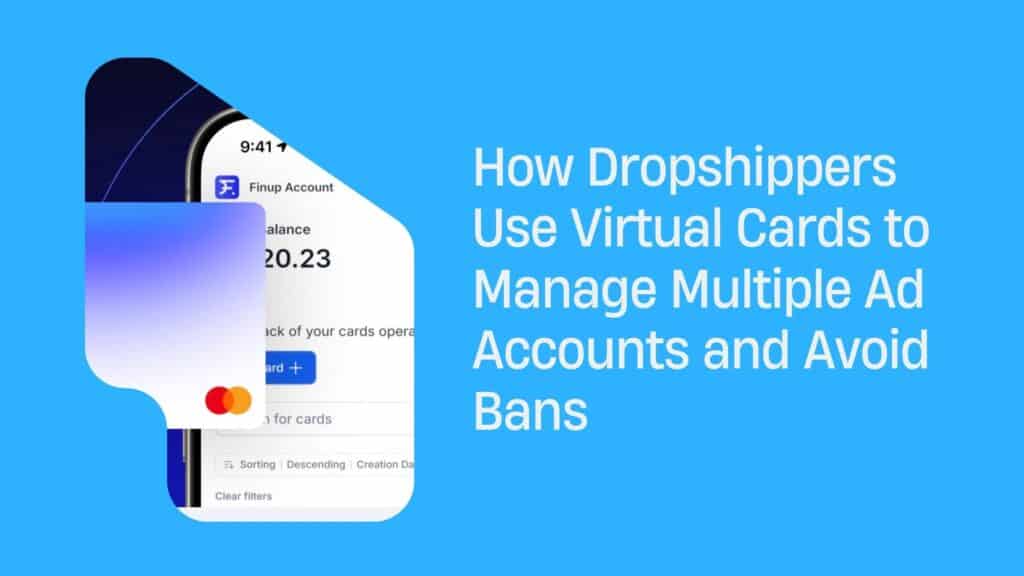
This is where virtual payment cards built for online businesses come in. Instead of running every ad account off one shared card, you issue a unique virtual card per account. Each card has its own number, its own BIN-level fingerprint, and its own spending limit. The platforms see them as distinct billing instruments because, technically, they are.
Done correctly, this dramatically reduces the cross-account signal that gets accounts banned. It also gives you something dropshippers rarely have: clean per-account performance data. You can see exactly how much each account spent, what it returned, and where to double down.
Setting Up Your Virtual Card System
Step 1: Issue One Card Per Ad Account
Sounds obvious, but plenty of operators still try to share. Do not. One card, one account, no exceptions. If you run ten Meta accounts, you have ten virtual cards. If you also run TikTok and Google, those are separate cards too.
Step 2: Set Strict Spending Limits
A blown ad budget is bad. A blown ad budget on an account that did not have a daily cap is catastrophic. Set per-card monthly limits that match your actual spend, plus a small buffer. If something goes sideways, the card declines instead of draining your bank account.
Step 3: Use Real Billing Information
Whatever billing details you put on the ad account need to match the cardholder details. Same business name, same address, same country. Mismatched info is a red flag even with virtual cards. The point of virtual cards is unique numbers, not fake identities.
Step 4: Track Performance Per Card
This is the underrated benefit. Most virtual card platforms give you transaction-level reporting per card, which means you can build a clean spend ledger per ad account. Plug it into your spreadsheet or BI tool and you finally have ROAS reporting that is not a guess.
Common Mistakes That Still Get You Banned
Even with a virtual card setup, dropshippers manage to find new ways to get banned:
- Logging into multiple accounts from the same browser session, regardless of the card. Use separate profiles or anti-detect browsers.
- Using the same phone number across accounts. Get unique numbers per account.
- Switching the card on an existing account too often. Pick one card per account and stick with it.
- Funding a virtual card from a flagged source. The platform looks upstream as well as at the card itself.
When Bans Happen Anyway: Recovery Tips
Even with the cleanest setup, bans happen. Here is the order of operations:
First, do not panic-spin up a new account on the same device, browser, IP, and card. That is the fastest way to get the new account banned within hours. Second, file an appeal calmly with documentation: business registration, ID, vendor invoices. The appeals process is automated for the first response and human after that. Third, if the appeal fails, start fresh on a different device, fresh account, fresh virtual card. The whole point of having a virtual card system is that resetting is cheap.
Final Thoughts
Dropshipping at scale in 2026 is a different game than it was three years ago. The platforms have gotten smarter, the bans hit faster, and the cost of getting it wrong is higher. Virtual cards are not a magic solution. They are a foundational piece of a setup that gives you the best chance of scaling without losing accounts on a Tuesday morning.
Treat your card setup as part of your account hygiene, not as an afterthought, and the bans get noticeably less frequent. You will still have the occasional bad week. You will just stop having them every other week.
Discover the Power of Inventory Source: An Introduction Video
Recent Articles
How to Normalize Shipping Methods Across Multiple Supplier
Learn how shipping method mapping normalizes supplier shipping codes, carriers, and delivery levels into one standard structure, so automated order routing selects the right service and keeps delivery estimates accurate across multiple suppliers.
Dropshipping Suppliers USA – Where to Find Them and How to Start
Learn where to find dropshipping suppliers USA, how to evaluate product data, shipping terms, and integration options, and the steps to start a US-based dropshipping business with reliable domestic fulfillment.
How to Calculate Accurate Delivery Estimates With Supplier Data
Learn how to calculate accurate ecommerce delivery estimates using supplier lead time, processing and cutoff schedules, business days, and carrier transit data, so you can set realistic delivery windows and reduce customer inquiries.