Peak-Season Supplier Capacity Planning for Ecommerce
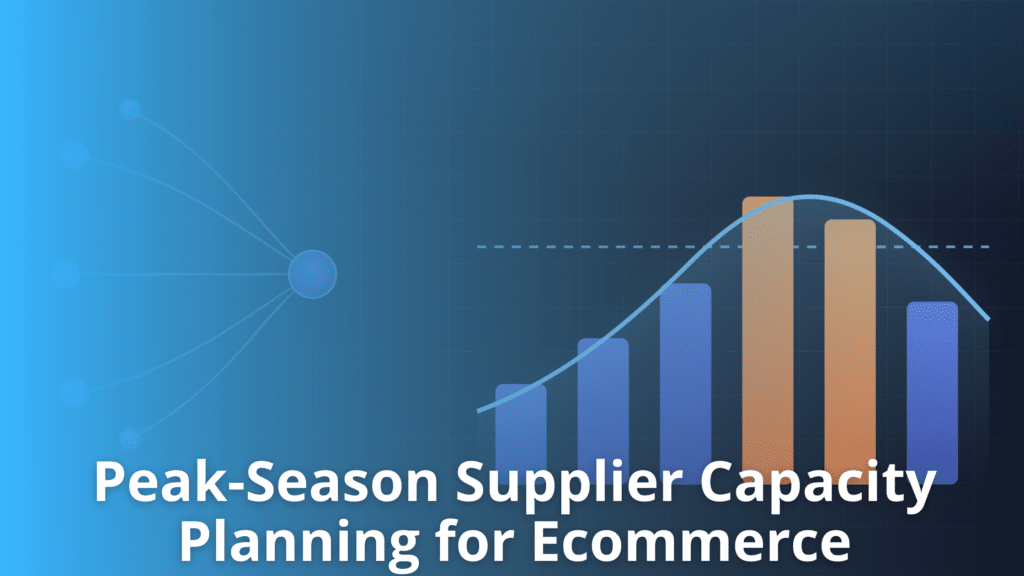
When order volume rises in peak season, the limit is often not your store, but your suppliers. A supplier that cannot ship the volume you sell turns a strong sale into late orders and cancellations. Supplier capacity planning is working out, before the peak, how much each supplier can handle and matching your demand to it. This guide covers forecasting demand, assessing each supplier’s capacity, planning backups, and watching performance during the rush. Done in advance, it keeps a volume spike from becoming a wave of orders you cannot fulfill.
What is Supplier Capacity Planning?
Supplier capacity planning is the process of estimating how much your suppliers can fulfill during a busy period and matching your expected demand to that limit. It looks ahead, before the peak, so a supplier is not overwhelmed by orders it cannot ship.
The work covers four steps:
- Forecast your demand for the peak.
- Assess each supplier’s limit.
- Match what you sell to what each supplier can deliver.
- Plan backups for when a supplier falls short.
The goal is to avoid taking orders your suppliers cannot deliver on time. This is a planning task done in advance, not a reaction during the rush, which is what separates it from managing stockouts as they happen. The stakes are real: IHL Group estimates that out-of-stocks cost retailers $456.3 billion worldwide. A supplier that runs out mid-peak is one source of exactly that lost sale.
Why Peak Season Strains Suppliers
Peak season pushes order volume far above a normal month, and suppliers feel that pressure too. Adobe forecasts that US online holiday sales will reach $275.1 billion in 2026, up 6.7 percent, with Cyber Week alone at $47.5 billion. That surge lands on suppliers as much as on stores.
A supplier shipping for hundreds of retailers at once can hit several limits during peak season fulfillment:
- Stock shortages on fast-selling items, as demand outruns what it stocked.
- Slower handling, as order volume passes what its team can pick and pack.
- Shipping backlogs, as parcels queue for carrier pickup.
- Allocation, as it rations limited stock across many retailers.
The strain is shared, so a supplier that is reliable in a quiet month may struggle under load. Supplier reliability is not fixed. It drops under pressure, which is exactly when a store needs it most.
Consider a supplier that comfortably ships 500 orders a day in October. In the week after Black Friday, every retailer it serves is sending more orders at once, so its daily queue doubles. The supplier has not shrunk; the combined demand has grown past what it was staffed for.
A retailer that planned around the October figure is now sharing a slower, fuller pipeline with everyone else, and its orders wait in line.
What Supplier Capacity Actually Means
Supplier capacity is not a single number. It is the lowest of several limits, and the tightest one sets the real ceiling.
| Part of capacity | What it limits | Example constraint |
| Stock | How many units the supplier holds for an item | 400 units on hand for a best-seller |
| Handling | How many orders it can pick and pack per day | 1,000 orders a day across all retailers |
| Shipping | How many parcels it can hand to carriers daily | Carrier pickup capped at a set volume |
| Allocation | How much stock it reserves for you versus others | 20 percent of an item held for your account |
A supplier with deep stock but slow handling is still limited by handling. Knowing which limit is tightest for each supplier is what makes a capacity estimate useful, rather than assuming stock alone decides what can ship. The real question is not “does the supplier have the product,” but “how many of my orders can it actually move per day during the busiest week.”
A quick way to find the tightest limit is to convert each part into the same unit: orders per day. A supplier with 400 units of stock but a handling limit of 100 orders a day can only move 100 of your orders a day, so stock is not the binding constraint. Framing every limit as orders per day makes them comparable and shows which one will run out first.
Forecast Your Peak Demand First
You cannot match demand to capacity without first estimating demand, so the forecast comes before everything else.
Use Last Year’s Data and Expected Growth
Start from last year’s peak volume, broken down by product and by supplier, then adjust for this year’s growth, your marketing plans, and any new products. Forecasting per supplier, not just overall, shows where demand will concentrate, which is what you later match against each supplier’s capacity.
A forecast should pull from a few inputs:
- Last year’s peak figures, by item and supplier.
- Your expected growth rate for this year.
- Planned promotions and the items they feature.
- New products with no history, estimated from similar items.
For example, if a product sold 300 units last peak and your store has grown about 20 percent, a baseline forecast is around 360 units, before adjusting for any promotion on that item. If you plan to feature it in a Cyber Monday email, the number could be higher still, so forecast a range rather than a single figure.
A forecast is an estimate, not a certainty, so build in a margin and plan for demand to land higher than the midpoint. The aim is a per-supplier view of how many orders each one is likely to receive, which is the number the rest of the plan works from.
Assess Each Supplier’s Capacity
You have to know each supplier’s limit before you can plan around it, and the limit comes from the supplier, not a guess.
Questions to Ask Each Supplier
Ask each supplier directly about the peak:
- Their holiday hours and any days they close.
- Their daily ship capacity during the busiest weeks.
- Their stock plans for your key items.
- Any allocation limits that cap how much they will reserve for you.
Holiday supplier planning starts with getting these answers in writing, not assuming last year’s limits still hold. A supplier’s capacity can change year to year as its own customer base grows.
Signs a Supplier Will Struggle
Some suppliers signal trouble before the peak even starts. Watch for:
- A supplier that cannot answer capacity questions clearly.
- One that shipped late or oversold during last year’s peak.
- One that holds thin stock on your best-selling items.
These are the suppliers most likely to fail under load, and the ones to plan a backup for first. A capacity assessment turns a vague sense of supplier reliability into specific numbers and known risks, which the matching step then acts on.
Match Demand to Supplier Capacity
This is the core of supplier capacity planning: aligning what you sell with what each supplier can deliver. It is where the forecast and the capacity assessment meet and become a decision.
Spread Demand Across Suppliers
If one supplier’s capacity is below your forecast demand for an item, split that item across more than one supplier, so no single limit caps your sales. Spreading demand also reduces the damage if one supplier fails, because no single source carries the whole item.
A simple worked example shows the logic:
| Item | Forecast demand | Supplier A capacity | Supplier B capacity | Plan |
| Best-seller X | 500 orders | 300 | 300 | Split across A and B, 250 each, with headroom |
| Item Y | 150 orders | 400 | n/a | Keep on A alone; capacity covers demand |
Set Per-Supplier Limits
Where a supplier has a hard capacity, cap how much you route to it, or how heavily you promote its products, so you do not sell past what it can actually ship. A limit set in advance is easier to hold than a stockout managed mid-rush. Matching is not a one-time step. As the forecast firms up closer to peak, adjust the split so it still fits each supplier’s confirmed capacity.
The split is also a hedge. If Supplier A fails on the Saturday of Black Friday weekend, half of that item’s demand is already flowing through Supplier B, so the loss is a delay on part of the volume rather than a full stop. A single-sourced best-seller has no such cushion, which is why the highest-volume items are the first to split.
Build Backup and Failover Plans
Even a sound plan meets surprises, so a backup is part of the plan rather than an afterthought.
Backup Suppliers for Best-Sellers
For your highest-volume items, line up a second supplier before the peak, so a stockout or outage at the first does not stop sales. A backup only works if it is ready in advance, because there is no time to onboard a new supplier during the rush.
A backup supplier should be:
- Connected to your store already, not onboarded mid-peak.
- Priced, so the switch does not break your margin.
- Stock-confirmed on the items it would cover.
Failover should route orders to the backup automatically where possible, since a manual switch during peak is slow and easy to miss. Automated supplier failover handles this by routing an order to a second vendor when the first is out. The goal is that a single supplier failure costs you one shipment’s delay, not a day of lost sales.
Test the failover before peak by forcing a switch on one order and confirming its routes and ships from the backup. A failover that has never been tested often does not fire when it is first needed.
Monitor Supplier Performance During Peak
Capacity planning does not end when the peak starts. It turns into monitoring, because the plan is a baseline and performance is what actually happens.
Metrics to Watch
Watch each supplier’s real performance against the plan:
| Metric | What it signals | Act when |
| Stock on key items | How close an item is to selling out | Stock drops faster than the forecast expected |
| Ship times | Whether handling is keeping up | Times climb above the supplier’s stated capacity |
| Order acceptance rate | Whether orders are being taken | Acceptance falls or orders queue unconfirmed |
| Error cancellation rate | Whether orders are failing | Errors or cancellations rise above normal |
Act Early on Warning Signs
A plan is only useful if you act on what it shows. If a supplier’s ship times climb, or its stock drops faster than forecast, shift volume to a backup before orders pile up, not after the backlog has formed. Early action is the difference between a quiet reroute and a public failure. The point of monitoring is to catch the moment a supplier starts to miss the plan, while there is still room to respond.
As an example, suppose a key supplier’s average ship time moves from one day to three over a single morning. That is not noise; it is the supplier falling behind its handling limit. Shifting new orders for its items to the backup for the rest of the day keeps your delivery promises intact, while waiting to see if it recovers risks a backlog that takes days to clear.
Communicate Plans With Suppliers
The plan works better when suppliers know it. Share your demand forecast with key suppliers ahead of the peak, so they can stock and staff for your volume rather than guess at it.
What to communicate:
- Your forecast volume for the peak.
- Your key items and expected best-sellers.
- Their shipping cutoffs and holiday hours, confirmed in writing.
- Any backup arrangements that involve them.
A supplier that knows your expected demand can plan for it, while one caught by surprise cannot. Holiday supplier planning is a two-way process, and the suppliers who plan with you are usually the ones who hold up best under load. The effort of sharing a forecast is small next to the cost of a supplier that was never told what was coming.
It also helps to agree on a point of contact and a response time for the peak, so that when something slips there is a known person to reach rather than a general inbox. The suppliers that give you a named contact for the season are usually the ones taking your volume seriously.
Plan for the After-Peak Period
Peak does not end cleanly. The rush is followed by returns, restocking, and a review of which suppliers held up. Returns in particular run high: the NRF expects 17 percent of holiday merchandise to be returned, part of nearly $850 billion in total US returns in 2025.
The after-peak period needs a short plan of its own:
- Return handling. Plan for a wave of returns and check each supplier’s return window, so refunds are not held up by a policy you did not confirm.
- Restock timing. Know when each supplier restocks, so your catalog recovers quickly.
- Supplier review. Score each supplier’s actual peak performance against the plan.
Use the review to adjust next year’s forecast and your sourcing. The supplier that struggled this year is a candidate to replace or to back up more heavily next time. The planning cycle closes with this review, so each peak makes the next one easier to plan rather than starting from memory.
A simple scorecard helps: for each supplier, record its on-time ship rate, its stockout days, and its error rate for the peak, next to the forecast you gave it. The suppliers that met the plan earn more volume next year; the ones that missed it move down the list or gain a standing backup. Reviewing while the peak is still fresh captures detail that fades within weeks.
Why It Fits Inventory Source
Supplier capacity planning is an operational planning angle on supplier reliability, which matters most when order volume rises quickly. That is where Inventory Source fits, because a capacity plan depends on accurate supplier data and the ability to see and move demand across suppliers.
The fit shows up in a few clear ways:
- Supplier capacity planning depends on knowing each supplier’s stock and performance, which rests on accurate, current supplier data.
- Inventory Source connects many suppliers and keeps their stock synced, so you can see where demand sits and spread it across sources.
- Backup and failover across suppliers is easier when those suppliers are already connected in one system, rather than onboarded in a hurry.
- For a seller whose volume rises fast in peak, supplier reliability is the operational risk this planning reduces.
The dropshipping software covers the wider toolset, and the dropshippers hub collects more guides. As demand and the supplier count grow beyond what one plan can manage by hand, teams often move to a platform built to route and balance orders across suppliers and channels at scale, such as Flxpoint.
Capacity, holiday hours, and allocation vary by supplier and change year to year, so sellers should confirm each supplier’s limits for their own setup. Treated as part of your ecommerce fulfillment planning, this work turns supplier reliability from a hope into a managed risk.
Conclusion
In peak season, your suppliers’ capacity, not your store, is often the real limit. Supplier capacity planning forecasts demand, assesses each supplier’s limit, matches the two, and lines up backups before the rush begins.
Monitor performance during the peak and act early on the first warning signs, then plan for returns once it is over. Done in advance, this planning turns a volume spike into orders you can actually deliver, rather than a wave of cancellations. The suppliers you plan around are the ones that keep your peak season profitable.
Discover the Power of Inventory Source: An Introduction Video
Recent Articles
Black Friday Firearms – A Seller’s Prep Guide for Dropship Gun Stores
Black Friday firearms demand runs all week, not one day. This seller’s prep guide covers distributor stock, GunBroker listings, FFL transfers, and ammunition, without oversells, stuck transfers, or shipping surprises.

Black Friday Customer Service for Dropshippers: 8 Message Templates for Stock, Shipping and Returns
During Black Friday week, the same questions flood your inbox. Speed up dropshipping customer service with eight ready templates for late orders, missing tracking, stockouts, address changes, cancellations and returns.
Supplier Integration Monitoring – Logs, Alerts & Failure Thresholds
A supplier feed or API can fail silently, leaving stale stock and wrong prices. Supplier integration monitoring uses logs, alerts, and failure thresholds to catch broken integrations before customers do.