Distributed Warehousing for Ecommerce – How Multi-Location Fulfillment Works
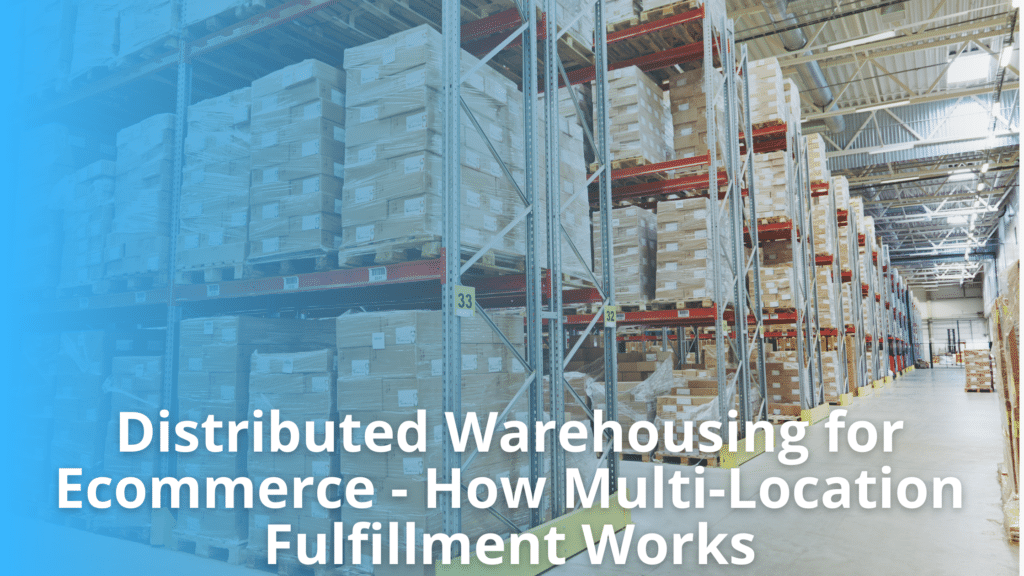
Shoppers expect orders to arrive quickly, and shipping everything from one warehouse makes that hard and costly. A single location is far from most customers, so parcels travel long distances and shipping costs climb. Distributed warehousing solves this by holding inventory in several locations, so each order ships from a site near the customer.
This guide explains how multi-location fulfillment works, from placing stock in the right locations to routing each order and keeping inventory accurate across every site. It also covers when the model is worth adopting.
What is Distributed Warehousing
Distributed warehousing is the practice of holding inventory in more than one location and fulfilling each order from the most suitable one. It replaces the single-warehouse model, where every order ships from one place no matter where the customer is.
The model rests on three parts that work together:
- Stock is split across locations – Inventory is placed in several sites rather than held in one.
- Each order is routed to a location – When an order arrives, the system decides which site should fill it.
- Inventory is tracked across all sites as one view – Every location reports to a shared record, so the system knows what is available and where.
Distributed warehousing is an operating model, not a single tool. Its value comes from shipping closer to the customer, which lowers both transit time and cost. The rest of this guide covers how each part works and how they connect.
Why Ecommerce is Moving to Multiple Locations
A single warehouse is simple to run, but it struggles as a business grows. Multi warehouse ecommerce addresses pressures that one location cannot.
The main drivers are:
- Delivery speed – A single warehouse is far from most customers, so transit times rise with distance. Orders to the other side of the country take longer to arrive.
- Shipping cost – Shorter distances usually mean lower shipping rates and fewer carrier zones crossed. Distance is one of the largest factors in parcel cost.
- Order volume – As volume grows, one location becomes a bottleneck for picking and packing. More sites spread the workload.
- Risk – One warehouse is a single point of failure. A problem there, from weather to a system outage, stops all fulfillment at once.
Consider a seller shipping from one warehouse on the east coast. An order to the west coast crosses the most carrier zones, takes the longest to arrive, and costs the most to send. The same order shipped from a west coast location would travel a fraction of the distance.
Multiplied across thousands of orders, that difference becomes a steady cost that a single warehouse cannot avoid.
Spreading inventory across locations addresses each of these pressures. It brings stock closer to customers, lowers shipping cost, shares the workload, and removes the single point of failure.
The trade-off is more complexity to manage, which the rest of this guide examines. The move to multiple locations is a response to growth, not a trend to follow for its own sake.
How Distributed Warehousing Works
Before the detailed steps, it helps to see the model at a high level. Distributed warehousing rests on two linked decisions, made for every product and every order.
Place Inventory, Then Route Orders
The two core decisions are where to hold each product, and which location fills each order:
- Placement is planned ahead – The seller decides where to hold each product, based on where demand sits. This is a slower decision, reviewed over time.
- Routing happens in real time – As each order arrives, the system decides which location should fill it, based on current stock and the customer’s location.
The two decisions depend on each other. Routing only works if the right stock is already in the right place. If placement is wrong, routing cannot send an order to a nearby site that does not hold the item.
The Systems That Connect It
Distributed warehousing needs two systems working together:
- One inventory view across all locations – A shared record of what each site holds, updated as stock moves.
- Routing rules – The logic that decides where each order goes.
Without a shared view, a location can sell stock it does not have, or an order can route to a site that is out. These two systems are the base for the detailed steps that follow.
Distribute Inventory Across Locations
Placing distributed inventory is the first planning decision. The goal is to hold each product where its demand sits, so most orders ship from a nearby location. Stock is not split evenly across sites. It is placed where it is most likely to be ordered.
Even placement wastes space and money, because it holds products in regions that rarely order them. Demand-based placement does the opposite. It puts fast-moving products close to the regions that buy them, and holds less in regions where they sell slowly.
Match Stock to Regional Demand
Different regions buy different products at different rates, so each location should hold what its region orders most.
To plan this:
- Review past orders by region to see what each area buys.
- Place the top products for each region in the nearest location.
- Adjust placement as demand shifts over seasons or over time.
For example, a product that sells heavily in one region but rarely in another should be stocked deep in the first region’s location and lightly, or not at all, in the second. Holding equal stock in both would leave inventory sitting idle where it does not sell, while tying up money that could cover faster-moving items.
Overstocking every item in every location raises holding costs, because more total inventory sits on shelves. Placement is therefore a balance between coverage, having stock near customers, and cost, not tying up money in stock that does not move. Good placement makes routing easier, because most orders then have a nearby location that holds the item.
Route Orders to the Right Location
Regional fulfillment is the real-time decision: sending each order to the location that should fill it. Routing weighs several factors on each order, not distance alone. A site may be closest but low on stock, so the system has to consider more than one condition.
Set Clear Routing Rules
A routing engine applies a set of rules to each order.
Common rules include:
- Closest location with stock – The nearest site that actually has the item, to cut distance and shipping cost.
- Stock level – Avoid a location that is running low, so it does not run dry and fail later orders.
- Split or single shipment – Decide whether a multi-item order ships from one site or several, since a split order can cost more to send.
Split shipments deserve a clear rule, because they carry a trade-off. Shipping a two-item order from two locations may get each item to the customer sooner, but it costs two shipments instead of one. Shipping both items from a single site that holds them costs less, but may travel farther.
The right choice depends on whether the seller values cost or speed more for that order type.
The rules should be set by the seller to match their priorities. A seller focused on cost may always route to the cheapest option, while one focused on speed may favor the closest site. Routing depends on accurate stock data to work, because a rule that sends an order to a site shown as in stock fails if that count is wrong.
Keep Inventory Accurate Across Warehouses
Multi location inventory accuracy is the base that placement and routing both depend on. Every location must report to one shared inventory view, so the system knows what is available and where. When that view is wrong, the whole model breaks down.
An inaccurate view causes clear problems:
- Overselling – A product shown as in stock has already sold, so the order cannot be filled.
- Misrouted orders – An order routes to a site that is actually out, then has to be moved or cancelled.
- Cancellations – The customer is told an item is unavailable after they ordered it.
Sync Stock Across Every Location
Stock levels change constantly as orders ship from each site, so the shared view must update often.
To keep it accurate:
- Sync each location’s counts to the central record on a tight schedule.
- Apply a buffer, so a lagging update does not push a location to oversell.
- Check for mismatches between the shared view and each site’s real stock.
Accuracy across locations is not a one-time setup. It is an ongoing sync that keeps the shared view close to the real stock at every site. Every later decision rests on this view being right.
Handle Stock Imbalances and Transfers
Demand does not match placement perfectly, so some locations run low while others hold surplus. Imbalances are normal and expected. The model works when there is a clear process to correct them:
- Rebalancing – Move stock between locations when demand shifts, so coverage stays even across sites.
- Backup routing – When the nearest location is out, route the order to the next best site rather than cancel it.
- Replenishment – Restock each location based on its own demand, not a single national figure, so each site holds what its region needs.
Rebalancing has its own cost, because moving stock between sites is itself a shipment. A transfer makes sense when it prevents many future orders from routing to a distant site, but not for a small, short-term gap.
The process should weigh the cost of the transfer against the cost of leaving the imbalance in place.
These steps keep the network balanced over time. Without them, a location that runs low stays low, and orders in its region route to sites farther away, which raises cost and delivery time. A clear correction process is what keeps the model working as demand moves.
Challenges of Distributed Warehousing
Distributed warehousing has real trade-offs. An honest view helps a seller judge whether the model fits.
The main challenges are:
- More complexity – More locations mean more data, more rules, and more to monitor. The operation is harder to run than a single site.
- Higher holding cost – Stock spread across sites can mean more total inventory, which ties up more money.
- Accuracy risk – A shared view across many locations is harder to keep correct than a single count.
- Split shipments – One order may ship from several sites, which can raise shipping cost and give the customer more than one parcel.
Weigh the Cost Against the Benefit
Distributed warehousing is not always the right choice.
The decision is a balance:
- On one side, the gain in delivery speed and lower shipping cost from shipping closer to customers.
- On the other, the added complexity, higher holding cost, and accuracy risk.
The right answer depends on order volume, how spread out customers are, and the products sold. A seller should weigh these together rather than assume more locations are always better.
This weighing is not a one-time decision. As a business grows and its customers spread, a model that did not make sense last year may make sense now. The costs and the benefits both shift with volume and reach, so the decision is worth revisiting as the operation changes.
When Distributed Warehousing Makes Sense
The model fits some operations and not others. It makes sense under clear conditions:
- Customers spread across regions – The wider the spread, the more a single warehouse costs in distance and time.
- High order volume – Enough volume to justify holding stock in more than one place.
- Delivery speed matters – A market where faster shipping affects whether customers buy.
- Products that ship often – Steady demand that supports stock in several locations without it sitting idle.
A practical way to decide is to look at where orders currently ship and how far they travel. If a large share of orders cross the country from a single site, the cost of that distance is already being paid. If most orders stay within one region, a second location may add complexity without a matching gain.
A small seller with customers in one region may not need a second location, because a single site already serves them well. A growing seller shipping nationwide often does, because distance from one warehouse becomes a real cost. The decision should rest on the operation and its customers, not on the model being newer or more advanced.
Measure Distributed Warehousing Performance
The model should be measured, so a seller can confirm it is working rather than assume it. Review results on a schedule and compare locations against each other, since one site may perform while another lags.
Metrics Worth Watching
A few measures show whether distributed warehousing is paying off:
- Average distance per order – How far the typical order travels from its fulfilling site to the customer.
- Average shipping cost – Whether cost per order is falling as orders ship closer.
- Share orders from the nearest location – How often routing picks the closest site with stock.
- Stock accuracy per location – How often the shared view matches real stock at each site.
Compared across locations, these numbers show where the model works and where it needs attention. A site with low stock accuracy may cause misrouted orders.
A low share of nearest-location orders may point to placement that no longer matches demand. The metrics turn the model from an assumption into a measured process.
Why It Fits Inventory Source
Distributed warehousing depends on one accurate inventory view across every location. That shared view is the base the whole model rests on, and it is the problem Inventory Source works on.
The connection shows up in a few clear ways:
- It is the foundation the model needs – Placement and routing both fail if the system does not know what each site holds, so an accurate shared view comes first.
- Inventory Source keeps stock current across sources – It syncs stock across sources and keeps connected stores updated, which is the base that multi-location fulfillment rests on.
- Accurate inventory makes routing reliable – When stock stays correct across locations, routing can send each order to a site that genuinely has the item, instead of one that is already out.
- It makes placement data-driven – Placement decisions can rest on real stock and demand data, rather than on guesses.
- The topic is a real requirement, not a side feature – This is dedicated content on distributed warehousing because accurate multi-location inventory matters in a competitive category, not as an afterthought.
The exact behavior depends on the supplier feed, the supported integration, and the configured features. Before relying on automation for multi-location inventory, sellers should confirm how stock across sources and locations is handled for their specific setup.
An accurate, shared inventory view, kept current across every site, is what makes distributed warehousing work in practice rather than in theory.
Conclusion
Distributed warehousing ships each order from a location near the customer, which cuts distance, shipping cost, and delivery time. The model works in three steps: place stock by regional demand, route each order to the right location, and keep inventory accurate across every site.
It fits sellers with customers spread across regions and enough volume to support stock in several places. The model holds up when inventory stays accurate across all locations and there is a clear process to correct imbalances. Measured over time, it turns distance from a cost into an advantage.
Discover the Power of Inventory Source
Recent Articles
How to Reconcile Orders Across Multiple Dropshipping Suppliers
How ecommerce order reconciliation matches orders, supplier confirmations, shipments, and costs across multiple dropshipping suppliers, so you catch missing fulfillments, billing gaps, and partial shipments before they reach the customer or the books.
Supplier Tracking Quality – Valid Tracking, Carrier Mapping & Status Accuracy
Learn how supplier tracking accuracy depends on valid tracking numbers, carrier mapping, and shipment status accuracy, so every fulfillment update is usable, trusted by customers, and accepted by your sales channels.
Supplier Product Lifecycle Management – New, Changed and Discontinued SKUs
Learn ecommerce product lifecycle management, from validating new supplier SKUs to managing changes, distinguishing stockouts from discontinued products, and setting removal rules, so your listings and inventory stay accurate as supplier catalogs change.