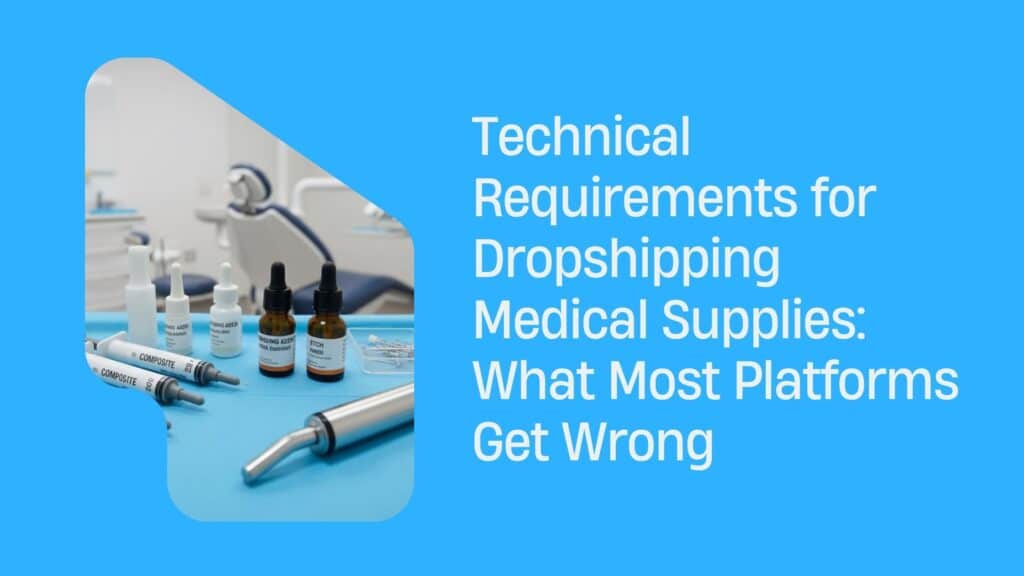
Technical Requirements for Dropshipping Medical Supplies: What Most Platforms Get Wrong
Why Medical Supply Dropshipping Requires Specialized Infrastructure
Overview of Medical Supply Dropshipping Complexity
Medical supply dropshipping operates under strict regulatory, logistical, and data constraints. Products require controlled handling, accurate classification, and continuous validation. Inventory must reflect expiration dates, batch identifiers, and compliance status. These requirements make medical supply wholesale structurally more complex than standard ecommerce models.
Limits of Generic Automation
General ecommerce automation platforms are designed for static consumer goods. They lack the controls required for regulated medical environments.
- Most tools do not support expiration-aware inventory logic.
- Batch and lot tracking is often unavailable or unsupported.
- Recall handling and supplier alert workflows are missing.
- Compliance documentation is treated as external data, not system-critical records.
Without these capabilities, automation introduces risk instead of efficiency. Medical supply wholesale requires systems built for validation, not just speed.
Supplier Role and Data Dependency
Medical equipment suppliers and wholesale medical supply distributors function as compliance gatekeepers. Their data accuracy directly impacts operational legality.
- Suppliers control batch data, expiration timelines, and recall notifications.
- Distributor feeds must include structured metadata, not simple SKU counts.
- Documentation, certifications, and change logs must remain synchronized with inventory records.
Effective medical supply dropshipping depends on deep integration with suppliers. The supplier relationship is a data partnership, not a transactional connection.
Regulatory and Operational Realities of Medical Supply Commerce
Medical supply commerce operates under strict regulatory and operational constraints. Platforms must account for compliance, traceability, and supplier accountability to avoid legal exposure and fulfillment failures.
Overview of Regulatory Exposure in Medical Supply Wholesale
Medical supply wholesale operates within a regulated environment shaped by healthcare laws, safety standards, and reporting obligations. Medical equipment suppliers and wholesale medical supply distributors must comply with documentation, recall handling, and product traceability rules that directly affect ecommerce operations.
Distinction Between Consumer Goods and Regulated Medical Products
| Dimension | Consumer Goods | Regulated Medical Products |
| Regulatory Oversight | Minimal or none | High oversight from health and safety authorities |
| Product Lifecycle | Static SKUs | Expiration dates, lot numbers, and recalls |
| Data Requirements | Basic product data | Batch, certification, and compliance metadata |
| Supplier Role | Fulfillment-focused | Compliance and documentation accountable |
| Returns Handling | Flexible | Restricted and often prohibited |
| Risk Profile | Operational risk only | Legal, regulatory, and patient safety risk |
| Platform Complexity | Low | High due to medical supply wholesale constraints |
Implications for Platform Design and Supplier Integration
- Platforms must support expiration-based inventory logic instead of static stock counts.
- Supplier integrations should capture batch, lot, and certification data from medical equipment suppliers.
- Order validation must prevent shipment of expired or recalled inventory.
- Data models must link products to compliance documents from wholesale medical supply distributors.
- Supplier feeds require higher accuracy and frequent validation checks.
- Automation workflows must include exception handling and audit trails.
- Generic dropshipping platforms lack these safeguards, increasing regulatory exposure in the medical supply wholesale.
Expiration-Based Inventory Logic and Stock Validity Controls
Expiration control is essential for medical dropshipping because product validity, safety, and regulatory compliance depend on precise inventory time tracking.
Expiration Awareness in Medical Wholesale
Expiration-aware inventory is mandatory in medical supply wholesale because product safety directly depends on time-bound usability. Medical items lose efficacy or become unsafe after defined dates. Systems must enforce this at all operational stages.
- Medical equipment suppliers distribute products with strict shelf-life limits.
- Wholesale medical supply distributors are required to prevent the shipment of expired or near-expired items.
- Regulatory audits often verify that expired stock is blocked at the listing and fulfillment stages.
- Inventory logic must account for minimum remaining shelf life, not just availability.
- Failure to manage expiration data exposes sellers to recalls, penalties, and platform enforcement actions.
Expiration logic must be embedded into inventory validation, order routing, and supplier synchronization. Treating expiry as optional metadata creates unacceptable compliance risk in medical supply wholesale operations.
Expiry Data Structures
To manage expiration correctly, inventory systems require structured, granular data models.
- Item-level fields for expiration date, manufacture date, and minimum sellable window.
- Batch-level records linking lot numbers to specific expiry dates.
- Quantity allocation mapped per batch, not per SKU only.
- Status flags for sellable, restricted, or blocked inventory.
- Supplier feed support for batch identifiers and expiry timestamps.
These structures allow accurate stock decisions across ordering, routing, and recalls.
Non-Perishable SKU Risk
Platforms that treat medical supplies as non-perishable SKUs introduce serious operational risk. Generic inventory models assume all units are interchangeable. This assumption fails in regulated medical environments.
- Orders may route expired inventory if the batch context is missing.
- Platforms cannot isolate affected lots during recalls.
- Medical equipment suppliers lose confidence in downstream compliance.
Without expiration logic, sellers may unknowingly violate distributor agreements and regulatory rules. Wholesale medical supply distributors expect systems to enforce expiry controls automatically. Platforms lacking this capability create exposure to financial loss, platform suspension, and patient safety incidents.
Batch-Level Tracking and Lot Identification Requirements
Medical supply dropshipping requires inventory logic that goes beyond standard ecommerce SKU tracking.
SKU vs Batch Inventory Models
| Dimension | SKU-Level Inventory Model | Batch-Level Inventory Model |
| Inventory unit | Single SKU represents all stock | Each batch or lot tracked separately |
| Expiration handling | Not supported or handled externally | Native expiration date per batch |
| Traceability | Limited to product-level history | Full traceability to production lot |
| Recall readiness | Manual and error-prone | Targeted isolation by lot number |
| Compliance fit | Suitable for general retail | Required for medical supply wholesale |
| Data source complexity | Simple feeds from suppliers | Structured batch feeds from wholesale medical supply distributors |
| Audit support | Weak audit trails | Strong audit and compliance records |
| Fulfillment logic | First-available inventory | Eligibility-based batch selection |
SKU-level models treat all inventory as interchangeable. This approach fails for regulated products. Batch-level models align with how medical equipment suppliers manage production, quality control, and recalls. They support compliance-driven operations.
Lot Numbers and Traceability
Lot numbers are mandatory for regulated medical supply wholesale operations.
They enable:
- Precise identification of affected units during recalls
- Verification of manufacturing and quality control records
- Alignment with audit and inspection requirements
- Faster root-cause analysis for defects or safety issues
Without lot-level traceability, platforms cannot support compliant fulfillment. This creates exposure for sellers relying on wholesale medical supply distributors.
Integration Challenges
Integrating batch data from wholesale medical supply distributors presents technical hurdles:
- Inconsistent lot number formats across suppliers
- Limited API support for batch-level fields
- Missing expiration or recall flags in data feeds
- High data volume from batch-level inventory updates
- Need for strict validation rules to prevent data loss
Platforms must normalize and enforce batch data structures to remain compliant.
Recall Management and Supplier Alert Infrastructure
Recall handling protects patients, platforms, and sellers by ensuring rapid product isolation and accurate supplier-to-system communication.
Recall Initiation and Communication
Recalls in regulated supply chains are typically initiated by manufacturers, regulators, or upstream distributors. Medical equipment suppliers detect quality defects, safety risks, or compliance failures through audits, adverse event reports, or regulatory notices. Once identified, recall notifications are issued with precise scope definitions. These include affected SKUs, batch or lot numbers, production dates, and risk classification.
Wholesale medical supply distributors act as intermediaries. They receive recall instructions and must relay them downstream without delay. Communication channels often include structured data feeds, secure portals, or compliance bulletins. Timing is critical. Any delay increases exposure to regulatory penalties and patient safety risks. Systems supporting medical supply wholesale must therefore ingest recall data in near real time and preserve message integrity.
System Capabilities for Recall Control
Effective recall handling requires platforms to move beyond basic SKU management. Core system capabilities include:
- Recall Mapping – Ability to associate recall notices with specific SKUs, lot numbers, and suppliers. This mapping must support partial recalls, not blanket product takedowns.
- Product Isolation – Automated suspension of affected inventory from listings, order routing, and fulfillment workflows. Isolation should occur immediately after recall ingestion.
- Order Interruption Logic – Prevention of new orders and interception of in-flight orders linked to recalled batches. Clear exception handling is required.
- Audit Trails – Persistent logs showing when recall data was received, actions taken, and inventory status changes. These records support regulatory review.
- Supplier Feedback Loops – Confirmation mechanisms to validate corrective actions from medical equipment suppliers and distributors before reinstatement.
Gaps in Mainstream Dropshipping Tools
Most general dropshipping platforms lack the architecture required for recall workflows. Common gaps include:
- SKU-Only Models – Platforms often ignore batch or lot identifiers. This makes targeted recalls impossible and forces full catalog suppression.
- Manual Alert Handling – Recall notices are treated as emails or documents, not structured data. This delays response and increases human error.
- No Real-Time Enforcement – Inventory feeds update on schedules. Recalled products may continue selling until the next sync cycle.
- Missing Compliance Context – Tools designed for consumer goods do not align with the obligations of wholesale medical supply distributors.
These limitations expose operators to regulatory risk and operational disruption. A robust recall infrastructure is not optional in regulated medical environments.
Supplier Data Integrity and Documentation Dependencies
Accurate documentation is the foundation of compliant medical supply operations and determines whether automation can be safely applied at scale.
Documentation Requirements from Medical Equipment Suppliers
Medical equipment suppliers must provide structured and verifiable documentation for every product they distribute. This includes product specifications, regulatory declarations, handling requirements, and manufacturer traceability records.
Wholesale medical supply distributors are expected to maintain consistent document formats and update cycles to support audit readiness and downstream platform validation.
- Certificates – Suppliers must maintain current certificates such as FDA registrations, CE markings, or regional approvals. These records must be machine-readable and linked to specific products to support automated validation in medical supply wholesale workflows.
- Compliance Records – Compliance records change over time due to renewals or regulatory updates. Platforms must track document versions, effective dates, and expiration timelines to prevent outdated approvals from remaining attached to active listings.
- Data Versioning – Each document revision should be logged with timestamps and source attribution. This ensures traceability during audits and supports controlled rollback if documentation errors are detected across supplier feeds.
Linking Documentation to Active Inventory and Order Records
- Assign unique document identifiers at the supplier level for every compliance record.
- Map document identifiers to SKU or batch records during supplier data ingestion.
- Enforce validation rules that prevent inventory activation without required documents. Attach document references to inventory records within the catalog database.
- Propagate documentation metadata to order records at the time of order creation.
- Validate documentation status again before order routing to fulfillment.
- Block fulfillment if certificates expire or are revoked mid-lifecycle. Maintain document links in historical order records for audit review.
- Sync documentation updates from wholesale medical supply distributors in real time.
- Log all document-to-inventory relationships for compliance reporting and traceability.
Integration Gaps in Mainstream Dropshipping Platforms
Mainstream dropshipping platforms are designed for consumer goods. They lack the technical depth required to support regulated medical supply workflows, compliance logic, and supplier data dependencies.
Generic Tool Limits
- Generic dropship tools assume uniform SKU behavior. Medical products require conditional logic based on expiration, batch, and compliance status.
- Most platforms cannot ingest structured data from medical equipment suppliers beyond basic SKU, price, and quantity fields.
- Supplier feeds from wholesale medical supply distributors often include compliance attributes that are ignored or discarded.
- Product status validation is typically absent. Platforms do not block listings tied to expired or restricted inventory.
- Documentation dependencies are unsupported. Certificates and regulatory records remain disconnected from active listings.
- These limitations force manual checks, reducing scalability in medical supply wholesale operations.
Missing Critical Controls
Medical supply dropshipping depends on time-sensitive and batch-specific inventory controls. Most platforms lack native support for these requirements, creating blind spots across inventory, fulfillment, and compliance workflows.
- Expiration dates are treated as static attributes or ignored. This allows the sell-through of expired products sourced from wholesale medical supply distributors.
- Batch and lot numbers are rarely stored or validated. Traceability breaks when recalls or audits require batch-level identification.
- Supplier alerts for recalls or compliance changes are not automated. Manual intervention becomes the only safeguard.
Shallow Integration Risk
Shallow integrations focus on surface-level data synchronization. They pull stock counts without validating context or constraints. This approach introduces systemic risk in regulated environments.
- Orders may route to medical equipment suppliers without verifying batch eligibility.
- Inventory updates lag behind supplier status changes. Expired or recalled items remain sellable.
- Compliance documentation is not enforced at the transaction level.
- Alert mechanisms are external to the platform. Response times increase.
- Audit trails are incomplete, weakening accountability.
In medical supply wholesale, these gaps increase regulatory exposure and fulfillment failures. Systems must enforce rules at every data exchange point, not just at listing creation.
Order Routing Constraints and Fulfillment Safeguards
Order routing in medical dropshipping must enforce eligibility rules at every step, ensuring only compliant, traceable, and valid inventory is released for fulfillment across regulated supplier networks.
- Routing Based on Inventory Validity
Order routing must evaluate more than stock availability. Systems should confirm expiration status, batch eligibility, and documentation completeness before assigning orders to medical equipment suppliers. This prevents fulfillment using inventory that is near expiry or missing required records.
- Supplier-Specific Routing Rules
Wholesale medical supply distributors often operate under different regulatory scopes and service levels. Routing logic must respect supplier constraints such as geographic restrictions, product authorizations, and fulfillment certifications. Static routing models introduce compliance and delivery risks.
- Batch and Lot-Level Fulfillment Controls
Medical supply wholesale operations require routing decisions at the batch or lot level. Orders should only be released if the assigned batch meets expiration thresholds and traceability requirements. SKU-level routing is insufficient in regulated environments.
- Pre-Fulfillment Compliance Validation
Before order transmission, systems must validate that all compliance conditions are met. This includes product classification, supplier eligibility, and documentation linkage. Automated validation reduces reliance on manual review and limits execution errors.
- Exception Handling and Order Holds
Routing frameworks must support conditional holds. Orders should pause automatically if the supplier feeds report recalls, batch changes, or data inconsistencies. Clear exception states prevent silent fulfillment failures.
- Shipment Confirmation and Audit Trails
Fulfillment safeguards extend beyond routing. Systems must capture shipment confirmations, batch identifiers, and timestamps. This creates a defensible audit trail and supports post-shipment investigations if issues arise.
- Limiting Cross-Supplier Substitution
Substituting suppliers to accelerate fulfillment is common in ecommerce. In medical contexts, substitution must be restricted. Orders should only reroute to approved wholesale medical supply distributors that meet identical compliance criteria.
- Scalability Without Risk Amplification
As order volume grows, routing logic must scale without relaxing safeguards. Rule-based automation ensures consistency while protecting operational integrity across expanding supplier networks.
Automation With Compliance Guardrails
Automation in medical dropshipping must enforce regulatory logic at every step, ensuring speed without sacrificing traceability, validation, or control across complex supplier and fulfillment workflows.
- Rule-Based Automation Design – Automation must operate on predefined compliance rules, not generic triggers. Systems should validate product eligibility, documentation status, and fulfillment constraints before any action executes. This is essential when integrating medical equipment suppliers, where regulatory conditions vary by product type. Rule engines must block non-compliant SKUs automatically and log every decision for audit readiness.
- Supplier-Centric Control Layers – Automation should adapt to supplier-specific constraints. Wholesale medical supply distributors often follow distinct batch, labeling, and shipping rules. Platforms must apply supplier-level logic that governs inventory updates, order acceptance, and fulfillment timing. This prevents downstream failures caused by treating all suppliers as operationally identical.
- Data Validation at Ingestion Points – Automated workflows must validate incoming data before it enters the system. Expiration dates, batch identifiers, and compliance attributes should be checked at feed ingestion. In medical supply wholesale operations, invalid or incomplete data must halt synchronization. This avoids propagation of errors into listings, inventory counts, and customer orders.
- Exception Handling and Escalation Paths – Not all scenarios can be automated end-to-end. Systems must detect exceptions such as expired lots, recall notices, or missing certificates. These events should trigger controlled pauses, alerts, and escalation workflows. Automation without exception logic increases regulatory exposure rather than reducing it.
- Auditability and Continuous Oversight – Every automated action must be traceable. Logs should capture data changes, order routing decisions, and supplier interactions. This level of visibility supports compliance reviews and internal governance. Automation becomes a compliance asset only when oversight remains continuous and measurable.
Designing Platforms Fit for Medical Supply Dropshipping
Medical supply dropshipping demands systems engineered for regulatory accuracy, traceability, and operational discipline. Platform design must align with compliance realities, not generic ecommerce assumptions.
Platform Gaps
Most ecommerce platforms are built for consumer goods. They fail when applied to regulated medical supply wholesale operations.
- Inventory models ignore expiration dates and batch dependencies.
- Order workflows lack validation against recalls or lot restrictions.
- Supplier feeds are treated as static catalogs, not compliance-sensitive data streams.
These gaps create risk exposure when working with medical equipment suppliers and regulated products. Automation without controls amplifies failure rather than reducing it.
Structural Requirements
Compliant operations require purpose-built architecture. Systems must support data depth and enforce rules at every stage.
- Inventory logic must include expiration, lot numbers, and eligibility status.
- Supplier integrations must ingest documentation, certifications, and alert feeds from wholesale medical supply distributors.
- Order routing must validate product eligibility before fulfillment.
- Audit logs and traceability must persist across inventory, orders, and suppliers.
This structure ensures that medical supply wholesale workflows remain accurate and defensible under regulatory review.
Long-Term Positioning
Sustainable dropshipping systems prioritize reliability over speed.
- Platforms should treat compliance logic as core infrastructure, not add-ons.
- Supplier data governance must be continuous, not limited to onboarding.
- Automation should reduce manual handling while preserving human oversight for exceptions.
By aligning system design with regulatory realities, dropshipping operations can scale responsibly while maintaining long-term operational resilience and platform trust.
Discover the Power of Inventory Source: An Introduction Video
Recent Articles
Dropshipping Suppliers USA – Where to Find Them and How to Start
Learn where to find dropshipping suppliers USA, how to evaluate product data, shipping terms, and integration options, and the steps to start a US-based dropshipping business with reliable domestic fulfillment.

How to Calculate Accurate Delivery Estimates With Supplier Data
Learn how to calculate accurate ecommerce delivery estimates using supplier lead time, processing and cutoff schedules, business days, and carrier transit data, so you can set realistic delivery windows and reduce customer inquiries.

Supplier Order Cutoff Times – How They Affect Ecommerce Fulfillment
Learn how supplier order cutoff times affect ecommerce fulfillment, covering cutoff versus processing time, delivery promises, order automation, managing multiple suppliers across time zones, and the metrics that keep dispatch schedules reliable.